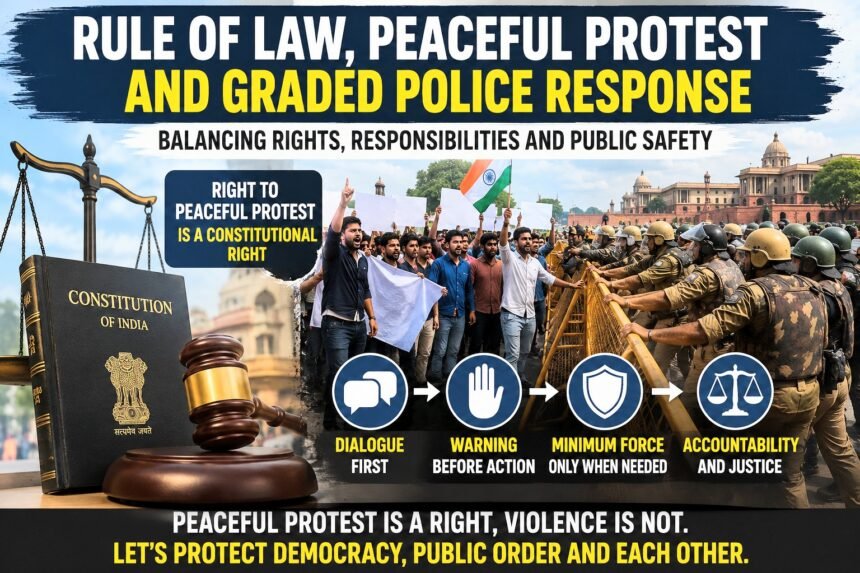
The right to peaceful protest is a cornerstone of every democracy. In India, Article 19 of the Constitution guarantees citizens the freedom to assemble peacefully. However, this right is subject to reasonable restrictions in the interests of public order, sovereignty, and security. Consequently, while authorities are duty-bound to facilitate lawful demonstrations, participants are equally responsible for complying with the conditions under which permission is granted.
When permission is accorded for a protest at a designated venue, it does not automatically authorize participants to march into restricted or high-security areas. Crossing police barricades, entering prohibited zones, or attempting to breach security perimeters transforms a lawful demonstration into an unlawful assembly. Such actions not only violate administrative directions but also create serious security concerns, particularly near vital government institutions.
The distinction between peaceful dissent and violent conduct is crucial. Democratic protest derives its legitimacy from its peaceful nature. Acts such as damaging public property, breaking barricades, pelting stones, or assaulting police personnel cannot be regarded as legitimate expressions of dissent. These actions threaten public safety, endanger lives, and undermine the democratic values they claim to uphold. Police officers, like all public servants, are entitled to protection while performing their constitutional duties.
In such circumstances, law enforcement agencies follow the principle of graded or calibrated use of force. This doctrine requires the police to employ the minimum force necessary to restore order, escalating only when persuasion, dialogue, warnings, and preventive measures prove ineffective. The objective is not punishment or retaliation but the protection of life, maintenance of public order, and safeguarding of critical infrastructure.
The use of graded force is governed by the principles of legality, necessity, proportionality, and accountability. Police intervention becomes justified only when there is a credible threat to public safety, government property, or security personnel. Where demonstrators disregard repeated warnings and attempt to breach protected areas, law enforcement has both the legal authority and constitutional obligation to prevent further escalation.
A democratic society depends on balancing civil liberties with the rule of law. Citizens have every right to voice their grievances peacefully, but those rights carry corresponding responsibilities to respect lawful restrictions and avoid violence. Similarly, police must exercise restraint while ensuring that public order is preserved.
Ultimately, the use of graded force should be understood not as an attempt to suppress democratic expression but as a lawful, measured, and proportionate response to situations where peaceful protest gives way to unlawful conduct, thereby protecting both constitutional freedoms and public safety.
Link : https://shricgnewscreator.com/rule-of-law-peaceful-protest-and-graded-police-response/