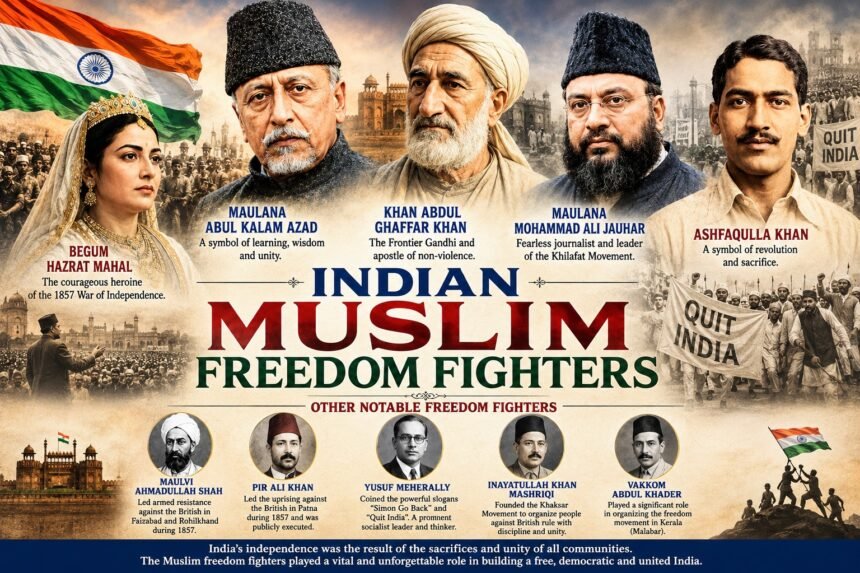
India’s struggle for independence was a long, arduous, and sacrifice-filled journey in which people from all sections of society, religions, and communities stood together. Among them, the contribution of Muslim freedom fighters was especially significant and unforgettable. Muslim leaders, intellectuals, religious scholars, revolutionary youth, and ordinary citizens alike laid down their lives and confronted British colonial rule on every front. This article presents a historical overview of the contributions of some of the most distinguished, as well as lesser-known, Muslim freedom fighters who helped lay the foundations of independent India.
Prominent Muslim Freedom Fighters
Maulana Abul Kalam Azad: A Symbol of Learning, Wisdom, and Unity
Maulana Abul Kalam Azad ranks among the foremost leaders of India’s freedom movement. He was not merely a politician but also an eminent Islamic scholar, journalist, Qur’anic commentator, and thinker. Through his newspapers Al-Hilal (1912) and later Al-Balagh, he sharply criticized the exploitative policies of the British government and awakened political consciousness among both Muslims and the wider Indian public.
Azad became the youngest President of the Indian National Congress and led the party during the crucial years from 1940 to 1946, when the Second World War was at its peak and India’s independence movement had entered a decisive phase. One of the defining features of his political philosophy was his unwavering belief in Hindu-Muslim unity. He strongly opposed the partition of India based on the Two-Nation Theory and consistently advocated a united and secular India. As independent India’s first Minister of Education, his contributions-including the establishment of the Indian Institutes of Technology (IITs) and the University Grants Commission (UGC)-laid the foundation of the country’s modern educational system.
Khan Abdul Ghaffar Khan: The Frontier Gandhi and Apostle of Non-Violence
Khan Abdul Ghaffar Khan, affectionately known as the “Frontier Gandhi” or “Bacha Khan,” was a towering Pashtun leader from the North-West Frontier Province (present-day Khyber Pakhtunkhwa). In 1929, he founded the Khudai Khidmatgar (“Servants of God”) movement, whose principal aim was social reform and peaceful resistance against British rule.
Organizing the traditionally martial Pashtun community along the principles of non-violence was one of his greatest historical achievements.
He actively participated in the Khilafat Movement and the Civil Disobedience Movement and spent nearly three decades in British prisons. Like Maulana Azad, he strongly opposed the Partition of India. When the Congress ultimately accepted partition, he famously remarked, “You have thrown us to the wolves.”
Maulana Mohammad Ali Jauhar: Fearless Journalist and Leader of the Khilafat Movement
Maulana Mohammad Ali Jauhar was one of the boldest and most eloquent leaders of India’s freedom movement. He wielded his pen as a weapon against British imperialism through his renowned English newspaper The Comrade and his Urdu newspaper Hamdard, conducting a powerful intellectual and journalistic campaign.
He was among the foremost leaders of the historic Khilafat Movement, which brought Hindus and Muslims together on a common platform against British rule. During the Non-Cooperation Movement, he worked closely with Mahatma Gandhi and endured imprisonment. His contributions extended beyond politics into education as well; the establishment of Jamia Millia Islamia stands as a testament to his vision and efforts.
At the First Round Table Conference in London in 1930, he declared: “I would rather die in a free country than return to a slave country.” Fate fulfilled those words: he passed away in London and was buried in Jerusalem.
Ashfaqulla Khan: A Symbol of Revolution and Sacrifice
While India’s struggle for independence witnessed extensive peaceful political activism, it also included a remarkable chapter of revolutionary armed resistance. Ashfaqulla Khan belonged to this revolutionary stream and was an active member of the Hindustan Republican Association.
He played a key role in the famous Kakori Train Action of 9 August 1925, in which revolutionaries seized government funds from a train carrying British treasury money. His close friendship and ideological bond with Pandit Ram Prasad Bismil remains a timeless example of Hindu-Muslim unity. When sentenced to death by the British government, Ashfaqulla Khan refused to seek mercy and embraced the gallows with extraordinary courage. His martyrdom inspired a new spirit of resistance among India’s youth against British colonial rule.
Begum Hazrat Mahal : The Courageous Heroine of the 1857 War of Independence
Whenever the First War of Independence (the Revolt of 1857) is remembered, Begum Hazrat Mahal’s name is recalled with great respect. After the British East India Company annexed the Kingdom of Awadh and exiled her husband, Nawab Wajid Ali Shah, to Calcutta, she refused to surrender to circumstances.
She placed her young son, Birjis Qadr, on the throne and assumed military and political leadership herself. She united people from different communities and religions and inflicted heavy losses on British forces during the Siege of Lucknow. Although she was eventually forced to retreat due to overwhelming British reinforcements, she refused the pension and privileges offered by the British and instead sought refuge in Nepal, where she passed away still longing for India’s freedom.
Beyond these nationally renowned figures, thousands of regional Muslim leaders and freedom fighters made invaluable contributions that remain embedded in the foundations of India’s independence.
Unsung Heroes of History: Regional and Lesser-Known Freedom Fighters
Maulvi Ahmadullah Shah
During the Revolt of 1857, he led armed resistance against the British in the regions of Faizabad and Rohilkhand. British officials, including Thomas Seaton, acknowledged his military leadership, bravery, and organizational abilities.
Pir Ali Khan
A bookseller from Patna by profession, Pir Ali Khan was deeply committed to India’s freedom. He led the uprising against the British in Patna during 1857 and was publicly executed for his role in the rebellion.
Yusuf Meherally
Few people know that two of the Indian independence movement’s most powerful slogans “Simon Go Back” and “Quit India”-were coined by Yusuf Meherally. A distinguished socialist leader and Mayor of Bombay, he played a vital intellectual and organizational role in the freedom struggle.
Inayatullah Khan Mashriqi (Allama Mashriqi)
He founded the Khaksar Movement and sought to organize the public against British colonial rule through military-style discipline and organization.
Vakkom Abdul Khader
Vakkom Abdul Khader played a significant role in organizing the freedom movement in Kerala (Malabar) and in mobilizing local people against British colonial rule at the regional level.
Conclusion
India’s independence was not the achievement of any single individual, religion, or community. Rather, it was the result of countless sacrifices and a collective struggle. The intellectual vision of Maulana Abul Kalam Azad, the non-violent leadership of Khan Abdul Ghaffar Khan, the revolutionary martyrdom of Ashfaqulla Khan, the military courage of Begum Hazrat Mahal, and the creative political leadership of figures such as Yusuf Meherally all helped bring the independence movement to its successful conclusion.
An objective study of history makes it clear that Muslim freedom fighters shed their blood and dedicated their lives at every stage of the struggle against British colonialism. Their sacrifices remain a shining chapter in the making of modern, democratic, and independent India.
A B Nadwi,
Islamic Scholar
Link : https://shricgnewscreator.com/indian-muslim-freedom-fighters/