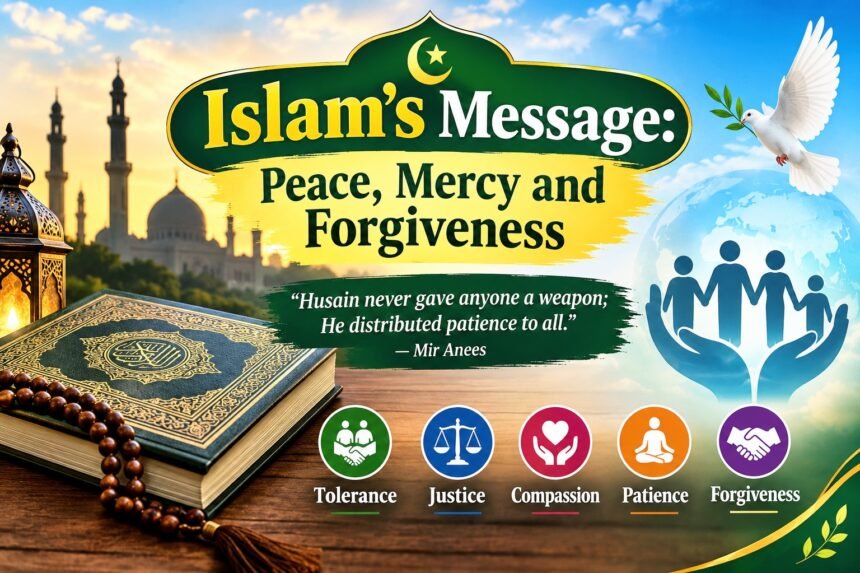
Poet Mir Anees has beautifully expressed the spirit of patience and restraint in the following couplet:
“Husain never gave anyone a weapon;
He distributed patience to all.”
It is in the light of this profound message that the subject deserves consideration today. At a time when differences of opinion, religious and social tensions, hatred and incidents of intolerance continue to surface in different parts of the world, there is an increasing need to understand those teachings of Islam that guide human beings towards patience, tolerance, compassion, justice and forgiveness. Islam is not merely a religion of worship; it also provides a comprehensive ethical framework in which human life, dignity, peace and social responsibility occupy a position of fundamental importance.
The Holy Qur’an teaches human beings to exercise self-restraint even in difficult circumstances and to adopt an ethical approach in responding to wrongdoing. In Surah Al-Ma’idah, verse 28, the statement of one of the two sons of Adam is narrated: if the other person extends his hand to kill him, he will not extend his hand to kill him, because he fears Allah, the Lord of all the worlds.
A profound ethical principle is contained in this verse. Even when a person has the ability or opportunity to retaliate, retaliation is not necessarily the only or obligatory response. At times, true strength lies not in defeating another person, but in exercising control over one’s anger, emotions and desire for revenge. It is at this point that morality, patience and consciousness of God elevate the character of a human being.
Islam does not teach acceptance of oppression or injustice. The Qur’an and Sunnah accord great importance to justice and fairness. However, justice and personal revenge are not the same. Taking the law into one’s own hands, resorting to violence or causing harm to another person in a moment of anger can further complicate social problems. Islam teaches human beings to seek justice through lawful, responsible and legitimate means
The life and conduct of the Holy Prophet Muhammad also provide numerous examples of mercy, forgiveness, good character and reconciliation. He emphasised kindness towards others and adopted wisdom, patience and gentleness. His teachings demonstrate that hearts can be brought closer not through hatred, but through good character, compassion and ethical conduct.
There is a particular need for this message in our society today. Differences of opinion should be transformed into opportunities for dialogue rather than hostility. In moments of anger, restraint and patience should be exercised. When someone makes a mistake, one should be given an opportunity to reform. Wherever possible, forgiveness and forbearance should be preferred, while injustice and wrongdoing should be addressed through lawful and peaceful means.
Islam’s concept of peace is not merely a slogan, it is a practical moral responsibility. A Muslim is expected to ensure that his or her conduct becomes a source of peace, welfare and goodness for others. If we adopt tolerance, justice, compassion, patience and forgiveness in our everyday lives, we can contribute to reducing hatred and social tensions.
The world today needs a message that brings people together rather than dividing them: peace instead of hatred, justice instead of revenge, wisdom instead of provocation and humanity instead of hostility. The strict adherence of such teachings of Islam demand not only bring a person closer to Allah but also promote love, respect and peace among human beings.
In addition, it is equally important to emphasise that the teachings of the Qur’an and Hadees must be understood in their complete context, in the light of the fundamental principles of Islam and the established and authentic scholarly tradition. This is essential to ensure that religious texts are neither misinterpreted nor used to justify violence or extremism.
Link : https://shricgnewscreator.com/islams-message-peace-mercy-and-forgiveness/