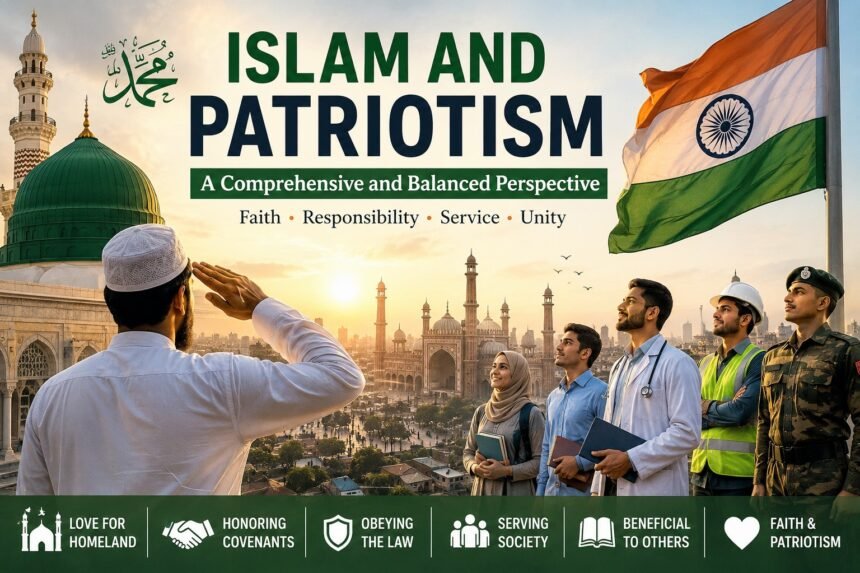
Love for the land where a person is born, drinks its water, and spends their childhood is a natural human instinct. Since Islam is the religion of fitrah (natural disposition), it not only acknowledges this innate feeling but also refines and guides it. In Islam, patriotism is not merely an empty slogan; rather, it is a beautiful combination of faith, morality, and social responsibility.
The Prophet Muhammad (peace be upon him)’s love for Makkah is a remarkable example of this. As he was leaving Makkah during the Hijrah (migration), he turned toward the city and said:
“How pure you are, and how beloved you are to me. Had my people not driven me out, I would never have chosen to live anywhere other than you.” (Jami’ al-Tirmidhi)
This blessed hadith is clear evidence that loving one’s homeland is in complete accordance with the Sunnah of the Prophet (peace be upon him) and the teachings of Islam.
In Islamic thought, love for one’s homeland is both an emotional and spiritual sentiment. After the Prophet (peace be upon him) migrated to Madinah and settled there permanently, he supplicated:
“O Allah! Instill in our hearts love for Madinah as we love Makkah-or even more than that.” (Sahih al-Bukhari)
Love for one’s homeland means sincerely praying for its progress, prosperity, and peace, and always being prepared to defend it.
Civic Responsibility
In Islam, being a citizen of any state or country means that one has entered into a social and legal covenant with that state. Islam places great emphasis on honoring covenants and agreements.
Allah Almighty says in the Holy Qur’an:
“O you who believe! Fulfil your covenants.” (Surah al-Ma’idah 5:1)
As citizens, paying taxes honestly, respecting traffic laws, keeping the environment clean, and safeguarding public property are all part of our responsibilities rooted in faith. A Muslim citizen never harms the resources of his or her homeland. The governance of any country rests upon its institutions-such as the judiciary, armed forces, police, healthcare, and educational departments-and its legal system. Islam attaches great importance to social order and the rule of law. Disorder and spreading corruption in the land are strongly condemned.
The Qur’an states:
“Obey Allah, obey the Messenger, and those among you who are entrusted with authority.” (Surah al-Nisa’ 4:59)
Respecting national institutions, cooperating with them, and abiding by the laws of the land are practical manifestations of this Qur’anic command.
It is equally important to remember that serving society through practical action and contributing, according to one’s ability, to the welfare of one’s country and nation are also expressions of love for the homeland.
Patriotism is not limited to waving the national flag or singing the national anthem. Rather, it demands meaningful service to society. A diligent student, an honest merchant, a conscientious teacher, and a patriotic laborer are all serving their country in their respective roles.
The Prophet Muhammad (peace be upon him) said:
“The best of people are those who are most beneficial to others.” (Al-Mu’jam al-Awsat by al-Tabarani)
Helping fellow citizens, working for the welfare of the poor, spreading knowledge, and strengthening the economy are all practical manifestations of true patriotism.
Conclusion
Islam presents a highly balanced and comprehensive understanding of patriotism. It teaches that love for one’s homeland should never turn into blind chauvinism, where one loses the ability to distinguish between right and wrong. Instead, patriotism should be constructive and guided by moral principles
A true Muslim, by living according to Islamic teachings, becomes the most exemplary, peaceful, and productive citizen of his or her country. When faith and patriotism come together, they become one of the greatest sources of a nation’s progress and prosperity.
A B Nadwi,
Islamic Scholar
Link : https://shricgnewscreator.com/islam-and-patriotism-a-comprehensive-and-balanced-perspective/