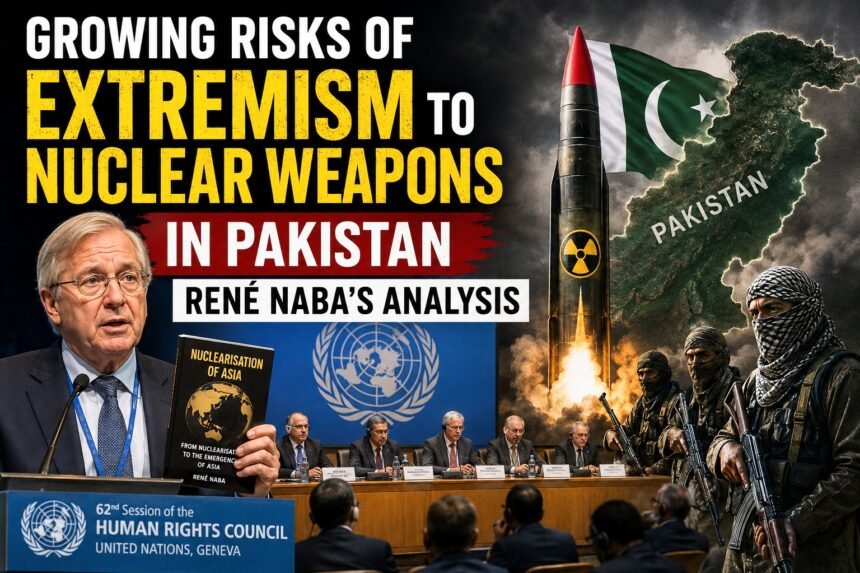
On 3 July 2026, an important international conference and panel discussion was held at the Sausalito Hall of Hotel NVY in Geneva, Switzerland. The event was organized as a side event during the 62nd Regular Session of the United Nations Human Rights Council (15 June-7 July 2026). It marked the official launch of the new book, Nuclearisation of Asia: From Nuclearisation to the Emergence of Asia , authored by renowned French journalist and geopolitical analyst René Naba.
A former head of the Arab-Muslim Desk at AFP News Agency, René Naba argues in his book that Asia is emerging as the world’s most significant continent in terms of population, economic growth, and nuclear capabilities. At the same time, he highlights the growing threats to international peace arising from violations of the Nuclear Non-Proliferation Treaty (NPT), the military application of artificial intelligence (Al), and increasing regional instability. The book also examines the evolving strategic partnership between China and Pakistan and its geopolitical implications.
The panel discussion brought together security experts and strategic analysts from different parts of the world. The participants broadly endorsed the concerns raised by René Naba and deliberated on several critical issues. The panel expressed concern that increasing public radicalization and the spread of militant ideologies in Pakistan could pose internal security risks to the country’s nuclear infrastructure. The return of the Taliban to power in Afghanistan and the growing activities of organizations such as Tehrik-i-Taliban Pakistan (TTP) were identified as serious challenges to regional nuclear security. Participants also discussed the gradual institutionalization of militant jihadist narratives and extremist ideologies within segments of Pakistan’s educational system over recent decades.
While Asia’s rise as a global power is inevitable, the internal challenges facing a nuclear-armed state such as Pakistan including extremism and terrorism pose significant risks to the global security environment. The panel urged the international community to adopt a coordinated strategy to address both conventional and emerging nuclear threats. To better understand the international concerns surrounding Pakistan’s nuclear assets, it is necessary to examine the principal issues frequently raised by foreign policy specialists and security analysts.
One of the foremost concerns is that severe political or economic instability within Pakistan could weaken state institutions and reduce the government’s ability to maintain effective control. Analysts argue that internal crises including terrorism, political unrest, and economic instability
can place considerable pressure on the personnel and systems responsible for protecting nuclear facilities, thereby increasing the possibility of insider threats.
Analysts such as René Naba contend that the growing influence of extremist ideologies and militant organizations within society could also present challenges for institutions responsible for safeguarding nuclear weapons. There are concerns that if lower- or mid-level personnel within security organizations become influenced by extremist ideologies, the integrity of the nuclear command-and-control system could be compromised.
The strained relationship between Pakistan and India continues to be viewed by the international community as one of the world’s most dangerous nuclear flashpoints. Security experts argue that any conventional military confrontation between the two countries carries the risk of rapid escalation into a nuclear conflict, making South Asia a persistent concern for international peace and security.
Although Pakistan maintains that its nuclear programme is fully secure under the oversight of the National Command Authority, critics often examine the issue through the lens of centralized versus delegated command structures. They argue that during periods of severe crisis, if central command mechanisms are disrupted, the possibility of operational errors or unauthorized use of nuclear weapons cannot be entirely ruled out.
Another factor frequently cited by analysts is the Islamization programme introduced during the rule of General Zia-ul-Haq. During this period, religious identity became increasingly integrated into state institutions, educational policies, and public discourse. While many of these measures were intended to promote national cohesion, critics argue that they also created an environment in which rigid interpretations of religion gained greater legitimacy. Over time, certain extremist organizations exploited this environment to justify violence in the name of religion, despite the fact that such actions have no basis in Islam’s ethical teachings.
Another significant issue concerns the A.Q. Khan proliferation network, which adversely affected Pakistan’s international reputation regarding nuclear technology proliferation. The incident raised broader questions about the robustness of state control mechanisms and whether unauthorized individuals could gain access to sensitive nuclear technologies. International observers argue that these concerns are not based solely on one historical episode but stem from the broader contradiction between sophisticated strategic capabilities and persistent political and institutional instability. While Pakistani authorities describe the country’s nuclear programme as a vital component of strategic deterrence and national defence, external analysts maintain that the security of nuclear weapons depends not only on technological capability but also on long-term political stability and strong institutions.
The central and long-term conclusion of the Geneva conference was that Asia’s emergence as a global power is both inevitable and irreversible, with the centre of global economic and political influence gradually shifting from the West to the East. However, the internal conditions prevailing in nuclear-armed states including societal radicalization, religious extremism, and terrorism continue to pose serious challenges to international security. The panel urged governments and the international community to formulate a comprehensive, transparent, and responsible global strategy to address not only traditional nuclear threats but also emerging risks such as the military application of artificial intelligence, cyber warfare, and the potential acquisition of nuclear materials by terrorist organizations. The participants emphasized that even a limited strategic miscalculation could have catastrophic global consequences.
While Asia’s strategic and economic rise is widely acknowledged, growing domestic extremism, militant influence, and persistent political and economic instability in a nuclear-armed country such as Pakistan remain significant obstacles to regional and global security. The protection of Pakistan’s nuclear arsenal requires not only advanced technical safeguards but also a stable political system, resilient institutions, and a moderate, inclusive society.
By Afif Ahsan
Link : https://shricgnewscreator.com/growing-risks-of-extremism-to-nuclear-weapons-in-pakistan-rene-nabas-analysis/