By Dr. Zafar Darik Qasmi
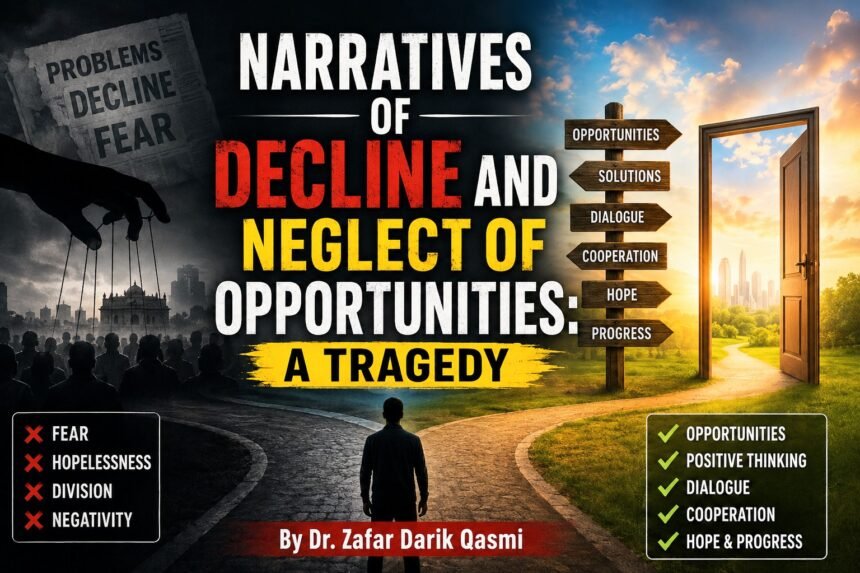
Abstract: This article explains that people often discuss decline, problems and fear but rarely talk about opportunities and solutions. Such negative narratives create hopelessness and increase fear in society. In India, many discussions about politics, especially after 2014, have focused mainly on problems faced by Muslims, while opportunities and practical solutions have been ignored. Similar attitudes exist in religious groups and academic circles, where people highlight differences instead of positive contributions. Societies progress when they promote hope, constructive thinking and meaningful dialogue. Instead of spreading fear, leaders should encourage people to focus on solutions, opportunities and cooperation. Positive narratives strengthen confidence, inspire action and protect society from anxiety, fear and despair.
Main Points:
•Excessive focus on problems creates fear, hopelessness and a sense of inferiority among ordinary people.
•Society needs leaders who discuss opportunities, solutions and positive ways to overcome challenges.
•Political narratives should promote dialogue instead of continuously increasing fear among different communities.
•Religious and academic groups should value cooperation rather than highlighting only differences and conflicts.
•Positive thinking builds confidence, encourages action and protects society from anxiety and hopelessness.
When we look at the world today, we can see that people’s emotions and feelings are often influenced deliberately. There are many reasons for this. One important reason is that discussions about problems and decline are very common, but
discussions about opportunities and practical solutions are rare. This situation gradually creates a sense of inferiority among ordinary people, while influential individuals directly benefit from it.
Those who continuously highlight problems, decline and one-sided views understand that if they begin to present opportunities and positive aspects, their influence over society may decrease. Therefore, repeatedly discussing decline and difficulties has become a practice that negatively affects society as a whole.
For a healthy and progressive society, it is necessary for leaders from every life to present ideas that promote positive and constructive thinking within the community.
If we look at the current political situation in India, we can say that the country is governed by the Bharatiya Janata Party. However, many social and political leaders have mainly told the Muslim community that this party creates problems for Muslims, is hostile towards them and may worsen the atmosphere of the country. Since 2014, many public narratives have focused only on these concerns. People have been given endless lists of problems, but opportunities and possible solutions have rarely been discussed.
As a result, fear of the BJP has grown among many people. Even today, anyone who speaks about opportunities or positive possibilities is often criticised. At the same time, those in power openly create fear among Hindus about Muslims. They also fail to acknowledge the contributions Muslims have made to the country. Such one-sided narratives are dangerous.
Therefore, political analysts, religious scholars and social leaders must avoid narratives that focus only on decline if they truly want to protect India’s culture and support social progress. Instead, they should discuss what can be achieved in difficult times, what opportunities still exist, how problems can be solved and what benefits dialogue with the government may bring.
We should ask ourselves an important question: when a government or political environment appears biased, is it right to continuously frighten a particular community? The answer is clearly no, because this only creates more problems and deepens existing fears.
A similar situation can be seen among different Islamic schools of thought. Followers of one school often highlight only the negative aspects of another school and deliberately ignore the positive contributions that could benefit society. This is often done to preserve influence and authority within their own groups.
The same problem can also be found in academic circles. Intellectual disagreements are sometimes used to increase personal status rather than to seek truth and knowledge. People insist on their own opinions and refuse to accept reasonable ideas from others. The purpose should be to promote knowledge and research, but instead many people simply want their own views to dominate, which creates unnecessary conflicts.
Whether in politics, religious differences or academic debates, one thing remains common: an excessive focus on problems. The Indian Muslim community must move beyond this approach and adopt plans that are based on opportunities, positive thinking and balanced attitudes.
If we continue to speak only about decline and difficulties, the damage will increase further. Challenges and problems have existed in every period of history. Wise societies never run away from them out of fear. Instead, they search for solutions, develop strategies to overcome difficulties and give priority to opportunities.
This approach encourages society, helps people learn how to deal with difficult situations and builds confidence. Positive narratives create hope. Their effects on society are reassuring and constructive. They give people courage and motivation to do good things. Most importantly, they protect society from fear, anxiety and hopelessness.
Therefore, one of the greatest services we can offer our community today is to ensure that our analyses and public narratives are not centred only on decline and problems, but are filled with opportunities, hope and positive thinking.
Dr. Zafar Darik Qasmi is an Islamic scholar, author and regular columnist for New Age Islam.
Link : https://shricgnewscreator.com/narratives-of-decline-and-neglect-of-opportunities-a-tragedy/