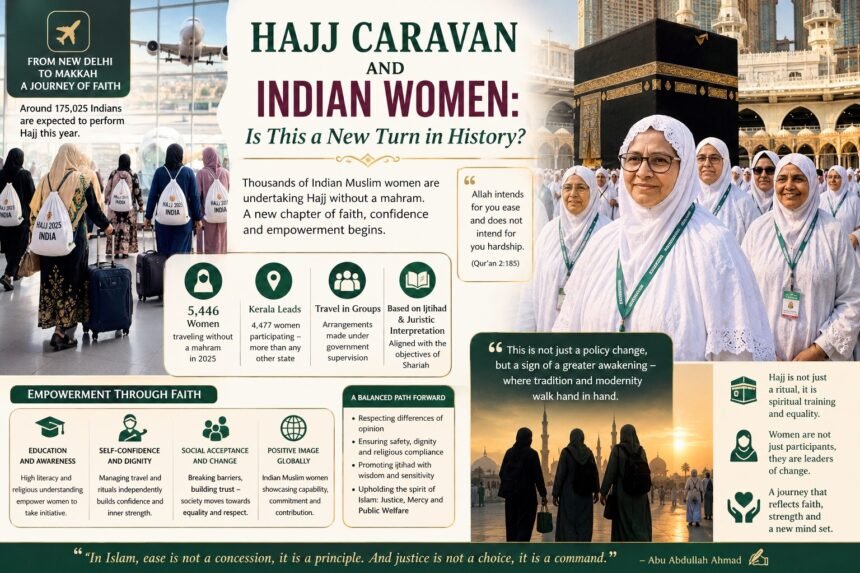
When the first batch of Hajj pilgrims departed from New Delhi for Saudi Arabia on Saturday, April 18, national media also reported that this year 5,446 Muslim women would undertake the pilgrimage without a mahram (a close male guardian). In this category, Kerala once again tops the list, with 4,477 women participating. This is the largest such group of women since 2018, when, for the first time, women aged 45 or above, who wished to perform Hajj but did not have a male mahram, and whose school of thought permitted it, were allowed to travel in groups of four or more. Overall, around 175,025 Indians are expected to perform Hajj this year.
Hajj is one of the five fundamental pillars of Islam, obligatory once in a lifetime for every Muslim who is capable. However, the condition of a mahram for women undertaking long journeys has long been a subject of juristic and social debate. In Islamic jurisprudence, the presence of a mahram has generally been considered necessary for a woman’s long-distance travel, based on certain hadees that discourage women from traveling alone. The primary purpose of this ruling was to ensure women’s safety, dignity, and social protection, especially in times when travel was fraught with risks.
However, the history of Islamic jurisprudence also shows that there has never been complete consensus on this issue. Some scholars, particularly from the Shafi’i and Maliki schools, hold that if the route is safe and the caravan is reliable, a woman may perform Hajj without a mahram.
This view is based on the principle that the objective of Shariah is to facilitate ease and protection, not to impose unnecessary hardship.
A fundamental principle of Islamic law states: “Allah intends for you ease and does not intend for you hardship.” Similarly, the objectives of Shariah (maqasid al-shariah) teach us that religious rulings are meant to ensure human welfare, protection, and dignity. In today’s world, where travel has become safe, organized, and collective with government supervision, group systems, and international arrangements, the question arises: should the condition of a mahram still be applied with the same strictness, or can its interpretation evolve according to changing circumstances?The policy introduced by the Government of India in 2018, allowing women to perform Hajj without a mahram under certain conditions, is in fact a practical expression of this tradition of ijtihad (independent reasoning). By permitting women to travel in groups, the policy aligns with the juristic concept of a “safe caravan.” This has not only enabled women to fulfil a religious obligation but has also strengthened their autonomy and dignity especially for widows or those without a mahram, for whom this is a significant facilitation. The recent development of thousands of Indian Muslim women undertaking Hajj without a mahram invite us to view this issue from a new perspective.
An important aspect of this development is social change. The large number of Muslim women traveling for Hajj without a mahram indicates that society is gradually moving toward greater trust, education, and empowerment. This change is not limited to religious practice but also strengthens women’s broader participation in society. A majority of these women are from Kerala. One reason is their adherence to the Shafi’i school of thought. Another major factor is education. Kerala has a literacy rate exceeding 98%, and Muslim women there are comparatively more economically stable, prosperous, and confident than women in many other states of India. At the same time, it is essential that this process is carried out with seriousness, religious awareness, and moral responsibility. Freedom and autonomy do not mean distancing oneself from Shariah; rather, they involve understanding and implementing its objectives more effectively.
It should also be remembered that differences of opinion still exist on this issue. Some scholars continue to consider the presence of a mahram essential. Therefore, it is important to respect these differences and not impose any single opinion forcefully. Government policies should also be implemented with sensitivity, ensuring that religious sentiments are not hurt and that no group feels that a particular interpretation is being imposed upon them. The issue of women traveling for Hajj without a mahram is, in fact, an example of the flexibility and expansiveness of Islam, which provides guidance in every era according to changing circumstances. It reminds us that Shariah is not a static system but a living framework that evolves in light of its core principles, justice, mercy, and public welfare.
Today, there is a need to promote informed, balanced, and insightful dialogue rather than emotional reactions. Ensuring women’s religious rights, safeguarding their dignity, and enabling them to become active participants in society are objectives that align perfectly with the spirit of Islam. This development is not merely a policy shift but a sign of a broader intellectual journey where tradition and modernity are not in conflict but complement each other.
Hajj holds a central place in Islam. It is not merely a ritual but a manifestation of spiritual training, collective consciousness, and human equality. The confidence, awareness, and dignity with which Indian women are undertaking this sacred journey today would have been unimaginable in the past. One notable aspect is the growing awareness of religious obligations. Indian Muslim women now have a clearer understanding of the significance, spirituality, and requirements of Hajj. They are no longer entirely dependent; rather, they actively participate in preparations, information gathering, documentation, and other arrangements. This awareness demonstrates that correct understanding of religion empowers individuals to take initiative. Alongside this, there is a visible rise in women’s self-confidence. Traveling for Hajj without a mahram under legal provisions is not merely an administrative convenience, it has enhanced their confidence, determination, and resilience. Their ability to manage travel, accommodation, and the performance of rituals shows that they are fully capable, both mentally and practically, of fulfilling this responsibility. a
While government policies have certainly played an important role in this transformation, the trend also reflects the gradual removal of social barriers. Traditional restrictions that once limited women’s mobility and decision-making are slowly diminishing. Families and society are increasingly accepting women’s choices, which is a sign of healthy and balanced social change. Education and awareness have played a crucial role in this shift. Both religious and modern education have made women self-reliant and informed. On an international level as well, this development presents a positive image that Muslim women are not only religiously aware but are also actively demonstrating their capabilities in social and practical spheres. This challenges stereotypical perceptions. The increasing participation of Indian women in Hajj especially their growing presence in journeys without a mahram is clear evidence of their religious commitment and self-confidence. This trend is not only a sign of positive individual transformation but also an indicator of a new mind set and awakening within the broader Muslim community.
zawiyah.delhi@gmail.com
Perspective/Zawiyah
Abu Abdullah Ahmad