The recent knife attack in Mumbai’s Mira Road has shaken the conscience of society. What makes this incident particularly disturbing is not only the brutality inflicted upon two innocent security guards, but also the alleged misuse of the religion to justify the act. According to reports, the attacker questioned the victims about their religion and forced one of them to recite the Kalma before stabbing them. This deeply troubling detail reflects how individuals, lacking proper understanding and moral grounding could weaponized faith against innocents.
Authorities have indicated that the accused may have been self-radicalised through online content and extremist narratives, with possible references to global terror ideologies found during the investigation. This raises serious concerns about the growing phenomenon of isolated individuals being influenced by toxic ideas without direct organizational control, leading to violent actions.
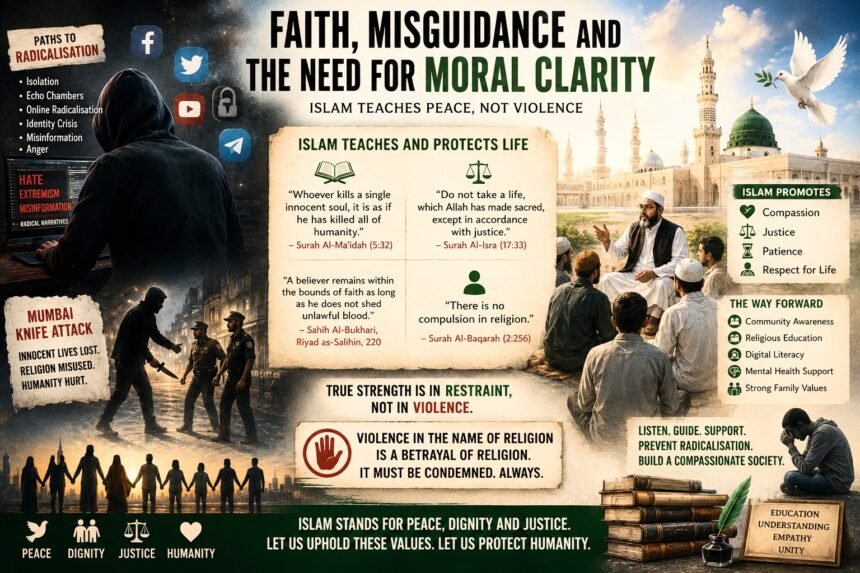
Radicalisation today operates through both online and offline pathways. Digital platforms such as social media and encrypted forums have become powerful tools for spreading distorted interpretations of religion. Individuals may gradually become trapped in echo chambers. where extreme ideas are normalized and reinforced. At the same time, offline factors such as isolation, broken family relationships, unemployment, or identity crises can increase vulnerability. When these personal struggles intersect with extremist narratives, they can produce a dangerous mind-set that falsely justifies violence.
It is important to clearly state that there is no justification in Islam for killing innocent people. The actions seen in this attack are not only criminal but fundamentally against Islamic teachings. The Quran declares that whoever kills a single innocent soul, it is as if he has killed all of humanity (Surah Al-Ma’idah, 5:32). This powerful message establishes the sanctity of human life as a universal principle. Another verse instructs believers not to take a life, which God has made sacred, except in accordance with justice (Surah Al-Isra, 17:33). These teachings leave no room for ambiguity and firmly reject violence against innocents.
The teachings of Prophet Muhammad, further reinforce this principle. He warned that a believer remains within the bounds of faith as long as he does not shed unlawful blood (Sahih Al-Bukhari, Riyad as-Salihin, 220). Even during times of war, he strictly prohibited harm to non-combatants, women, children, and religious clergy (Sahih Muslim 1744). This demonstrates that Islam maintains strict ethical limits even in extreme circumstances, making acts of violence in peaceful settings even more unacceptable.
Renowned Islamic seminaries such as Darul Uloom Deoband and Al Azhar University have consistently condemned acts of terrorism and violence carried out in the name of religion. In many Friday sermons, scholars emphasize that harming innocent people is forbidden under all circumstances. They also clarify that concepts like Jihad are often misunderstood and misused, whereas in reality Islam promotes compassion, justice, and patience. A commonly repeated message in such sermons is that true strength lies in controlling anger and showing restraint, not in causing harm to others.
One of the most disturbing aspects of the Mumbai attack is the reported attempt to use religious identity as a tool of intimidation. Forcing someone to recite the Kalma before committing violence contradicts the very essence of Islamic belief. Faith in Islam is based on free will and sincere conviction, not coercion. The Quran clearly states that there is no compulsion in religion (Surah Al-Baqarah, 2:256), making it evident that any attempt to impose belief through fear or violence is a violation of Islamic principles.
Incidents like this highlight the need for a collective response. Community awareness is essential so that religious leaders, educators, and families can address misconceptions and guide young people toward authentic teachings. Digital literacy and monitoring are equally important to counter the spread of extremist propaganda online. Mental health support also plays a crucial role, as many individuals who fall into radical thinking often struggle with isolation or emotional distress. Addressing these issues early can prevent harmful outcomes.
Ultimately, the Mumbai knife attack is not just a matter of law and order but also a reminder of how dangerous distorted ideologies can become when combined with personal vulnerability and misinformation. Such acts must be condemned without hesitation, especially in light of Islamic teachings that clearly prohibit violence against innocent people. Islam at its core stands for peace, dignity, and justice. It is the responsibility of society as a whole to ensure that these values are upheld and that no one is allowed to misuse religion as a justification for harm.
Insha Warsi
Francophone and Journalism Studies,
Jamia Millia Islamia.