Rapidly changing social, political, and intellectual scenario around the world have compelled Muslims to reconsider their foundational concepts in a new context and interpret them in a way that not only preserves their religious identity but also enables them to become a positive, active, and constructive force in society. Among these foundational concepts, one of the most significant is the concept of the Ummah, which has always remained central to Islamic thought. In the modern era, however, there is a pressing need to re-examine and interpret this concept so that it may serve as a practical and social force rather than merely an emotional or slogan-based idea.
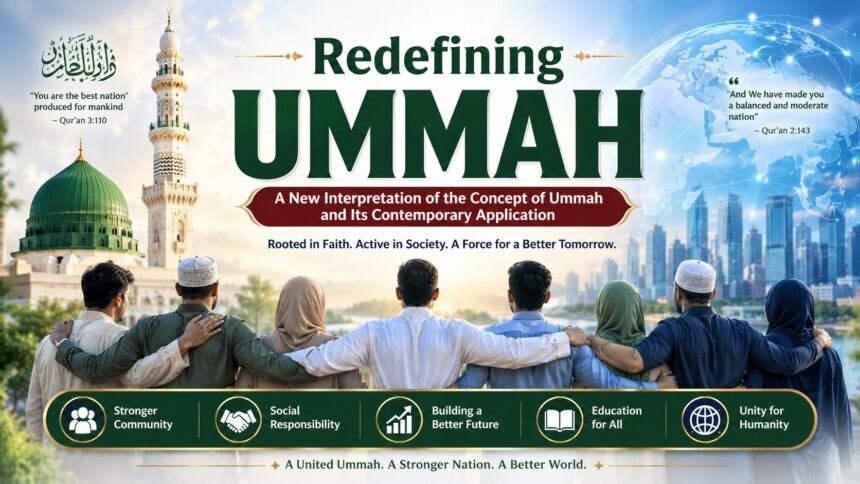
The term Ummah in Arabic refers to a group of people united by a common purpose, belief, or ideology. In Islamic terminology, it denotes the global community bound together by faith, morality, and shared values. The Holy Qur’an states: “You are the best nation produced for mankind” (Aal-e-Imran 3:110). It also says: “Thus We have made you a balanced and moderate nation” (Al-Baqarah 2:143). These teachings make it clear that the concept of Ummah is not limited to religious identity alone, it also carries an active social responsibility.
However, in contemporary times, the concept of Ummah is often confined to the realm of religious emotions, while its practical and social dimensions are overlooked. As a result, it is sometimes portrayed as being at odds with national unity, interfaith harmony, and social progress, whereas the reality is quite the opposite.
If understood in its true spirit, the concept of Ummah can coexist harmoniously with the modern nation-state and can even contribute to strengthening it. Islam teaches global brotherhood while simultaneously emphasizing local responsibilities. The life of Prophet Muhammad provides the best example of this balance. In the city-state of Madinah, he established a social contract among different tribes and religious communities, known as the Constitution of Madinah (Mithaq-e-Madinah). Furthermore, the Prophet said: “A believer to another believer is like a building whose different parts strengthen one another” (Bukhari and Muslim).
In today’s world, the concept of Ummah should be presented in a manner that promotes national unity. A Muslim can simultaneously be a member of the global Ummah and a responsible citizen of a nation-state. These two identities are not contradictory; rather, they complement each other. When a Muslim works for the development, peace, and stability of his or her country, that effort ultimately serves the broader interests of the Ummah. The Qur’an emphasizes the importance of fulfilling agreements and obligations: “Fulfill your covenants” (Al-Ma’idah 5:1), highlighting the significance of civic responsibilities.
The concept of Ummah can also play a vital role in fostering interfaith trust and harmony. Islam consistently teaches justice, tolerance, and good conduct. The Qur’an declares: “Indeed, Allah commands justice and excellence” (An-Nahl 16:90). It further states: “Allah does not forbid you from showing kindness and acting justly toward those who have not fought you because of your religion” (Al-Mumtahanah 60:8). Viewed from this perspective, the concept of Ummah can provide a strong foundation for interfaith dialogue and peaceful coexistence.
Moreover, the concept of Ummah can serve as a powerful instrument for social development. If the Ummah is regarded as a responsible social entity, each of its members will strive to contribute to the betterment of society. In areas such as education, healthcare, economic justice, and human rights, the active role of the Ummah can help build an ideal society. In this regard, the Prophet said: “The best of people are those who are most beneficial to others.”
For this to happen, however, the concept of Ummah must be liberated from. extremism, narrow-mindedness, and emotional rhetoric, and transformed into a positive, constructive, and practical framework. Scholars, intellectuals, and social leaders should present interpretations of this concept that are compatible with the realities and challenges of the modern world and that prepare Muslims to become responsible global citizens.
Education can play a fundamental role in this process. Curricula should include subjects that provide students with a comprehensive and balanced understanding of the Ummah. Young people should be taught how to maintain their religious identity while living harmoniously with others and contributing positively to society.
Similarly, media and social media can significantly influence how the concept of Ummah is understood and applied. If used positively, these platforms can present the Ummah as a constructive force that benefits not only Muslims but humanity as a whole.
In conclusion, the concept of Ummah is a comprehensive and inclusive idea which, if understood and applied correctly, can provide intellectual and social guidance for Muslims while contributing to the creation of a peaceful, harmonious, and progressive society. The Qur’an associates the responsibility of the Ummah with promoting goodness and righteousness, while the teachings of the Prophet demonstrate its practical implementation. The need of the hour is to move beyond limited historical interpretations and present the concept in a modern, balanced, and practical form so that it can effectively address contemporary challenges. Doing so, will not only benefit the Ummah, but humanity at large will also gain from its positive contributions.
(Writer Sahabuddin is Delhi based Islamic Scholar and social thinker.)
Link : https://shricgnewscreator.com/re-defining-ummah-a-new-interpretation-of-the-concept-of-ummah-and-its-contemporary-application/