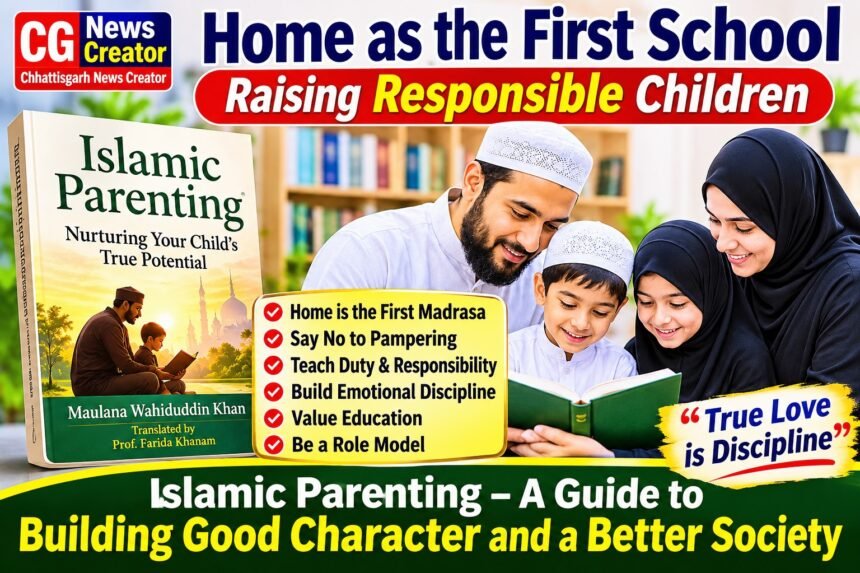
Islamic Parenting: Nurturing Your Child’s True Potential, translated by Prof. Farida Khanam from Maulana Wahiduddin Khan’s Urdu work Tarbiyat-e-Aulad (2019), is a concise yet morally rigorous guide to raising children within an Islamic framework. The book’s central thesis is that parenting extends far beyond the material provision of food, clothing, and affection. Instead, it is the deliberate cultivation of character, conscience, responsibility, and intellectual capacity. Khan argues that modern parents often mistake material security for true upbringing, focusing heavily on external achievements and future wealth while neglecting the inner development of the child. The book serves as a corrective to this trend, urging parents to view the home as the primary institution for value transmission and to recognize that a child’s environment is more formative than lectures or outward religious symbols.
The Home as the First School
A foundational concept in the book is the idea that the home is the “first madrasa” (school). Khan posits that a better home creates a better society, treating the family not as a private refuge detached from public life, but as the primary engine for social and moral formation. Children learn through observation before they learn through instruction. They absorb values by watching how parents manage anger, treat elders, handle financial matters, and interact with neighbors and strangers. This perspective shifts the focus of parenting from academic achievement and school selection to holistic formation. Khan warns that a child may excel academically yet remain emotionally immature or spiritually hollow if the home environment lacks models of patience, gratitude, and ethical conduct.
The author emphasizes that Islam is not merely a set of rituals but a comprehensive way of living that shapes conduct and relationships. This approach corrects superficial understandings of tarbiyah (upbringing) that reduce religious identity to external markers. By fostering a conducive religious and moral environment at home, parents ensure that their children’s faith is rooted in internal transformation rather than mere compliance.
Critique of Pampering and “Child Worship”
One of the book’s most striking contributions is its critique of excessive pampering, which Khan terms “child worship.” He argues that when parental affection is not balanced with discipline and responsibility, it disconnects children from reality. Pampered children often grow up expecting the world to adjust to their desires, lacking the endurance, gratitude, and resilience needed to face life’s difficulties. Khan challenges the assumption that accumulating wealth and property for children is the highest expression of love. Instead, he asserts that true success is determined by diligence, planning, hard work, and a realistic outlook. This critique has broad social relevance, extending beyond religious
contexts to address a common pathology in middle-class and affluent families where children are shielded from household responsibilities and failure. Khan warns that such over-protection can become a form of blindness, where parents ignore the mistakes of family members, thereby preventing necessary correction and growth. The book draws a sharp distinction between love and indulgence: love seeks the child’s long-term welfare and prepares them for life, whereas indulgence seeks immediate approval and disables the child for life. Khan’s tone remains compassionate, refusing to romanticize parental sacrifice when it results in dependence rather than maturity.
Duty, Consequences, and Emotional Discipline
Central to Khan’s philosophy is the cultivation of “duty consciousness.” Children must be taught that they have obligations toward their family, society, and God. They must learn that rights are accompanied by responsibilities, and that a person trained only to receive will struggle to become a constructive member of society. Equally important is the understanding of consequences. Khan argues that modern parenting often harms children by protecting them from the natural results of their actions, whether academic, social, or moral. Children need guidance, but they also need to learn that choices have outcomes, a lesson essential for adult life where responsibility cannot be outsourced to parents.
The book also places significant emphasis on emotional discipline. Parents are urged to control their anger, endure personal losses, and manage the emotional climate of the home. Khan notes that children are often damaged less by explicit teachings than by the household’s emotional atmosphere. A home marked by shouting, resentment, or mutual blame teaches insecurity, regardless of verbal instructions to be calm or pious. Additionally, Khan advises spouses to maintain a strong marital bond, warning that when a marriage becomes entirely child-centered, spouses may grow distant, and the child becomes an object of anxious over-investment rather than being nurtured within a stable partnership.
Education as the Best Gift
Khan identifies education as the most valuable gift parents can give their children. For him, education is not merely the acquisition of certificates or job skills, but the creation of awareness and the broadening of vision. He warns against “intellectual dwarfism,” a condition where individuals remain mentally narrow despite material comfort. This critique is particularly relevant for communities that prioritize wealth, lineage, or social prestige over learning. Khan argues that genuine progress is impossible without education, using historical examples such as Japan’s post-1945 rebuilding through knowledge and the early Muslim emphasis on literacy during the Battle of Badr to illustrate the civilizational power of learning.
The author’s stance on gender is also noteworthy. He explicitly rejects discrimination against girl children and affirms the importance of women’s education. In contexts where gender prejudice still limits access to schooling, this affirmation makes the book a useful resource for promoting educational justice within an Islamic framework.
Modern Challenges and Role Models
Addressing contemporary issues, Khan criticizes television culture and screen addiction for weakening teaching and replacing meaningful engagement with passive consumption. In the age of smartphones and social media, his warning against triviality is even more urgent. He advises parents to prioritize wisely, avoiding the expenditure of emotional energy on minor disputes (such as dress or status) while neglecting essential values like character and mental health.
Finally, Khan stresses the importance of parents serving as role models.
Children may ignore advice, but they rarely fail to notice example. A parent who preaches humility while displaying arrogance, or honesty while practicing deceit, will not produce the desired character in their children. Therefore, parenting is presented as a project of self-reform. Parents are urged to have realistic expectations, recognizing each child’s distinct abilities and limitations, rather than imposing unfulfilled dreams. The book concludes with a call for a “spirit of action,” training children not just to dream, but to work, plan, and persevere.
Conclusion
While Islamic Parenting has limitations-such as its brief, aphoristic style and lack of specific strategies for modern issues like digital safety or special needs-it remains a wise and timely text. It is not a clinical manual but a moral invitation for parents to recover seriousness, balance, and purpose in raising children. By refusing to separate spirituality from responsibility, love from discipline, or education from character, Maulana Wahiduddin Khan offers a timeless guide for raising responsible, educated, and self-reliant individuals. The book is recommended not only for Muslim parents but for all caregivers seeking to nurture the true potential of the next generation.
Link : https://shricgnewscreator.com/home-as-the-first-school-raising-responsible-children/