In today’s digital world, information travels faster than ever before. A message shared on social media can reach thousands of people within minutes. While this technology has made communication easier, it has also created a serious problem and that is misinformation. False news, edited videos, hate speeches, conspiracy theories, and emotional propaganda are spreading rapidly across society. Many people believe and forward such content without checking whether it is true or false.
This situation has affected communities, relationships, and even national harmony. Rumours have caused violence, hatred, and fear in many parts of the world. In such an environment, critical thinking has become extremely important. Critical thinking means using reason, knowledge, and evidence before accepting or sharing any information. It teaches people to ask questions, verify facts, and think calmly instead of reacting emotionally. Interestingly, Islam strongly supports this approach. The Quran and the teachings of Prophet encourage believers to think deeply, seek knowledge, and avoid blindly following rumours or assumptions.
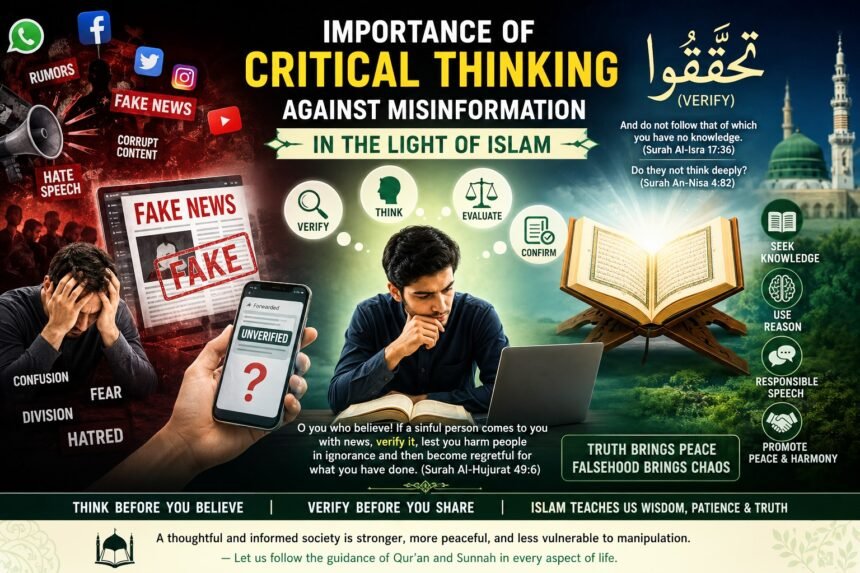
One of the clearest Islamic teachings regarding misinformation is found in the Quran: “O you who believe! If a sinful person comes to you with news, verify it, lest you harm people in ignorance and then become regretful for what you have done.” (Surah Al-Hujurat 49:6). This verse provides a timeless principle for modern society. Before believing or forwarding any information, Muslims are instructed to verify it carefully. Today, this applies directly to social media posts, WhatsApp forwards, viral videos, and online speeches. Many conflicts in society begin because people react emotionally to unverified information. Islam teaches believers to pause, investigate, and think wisely before making judgments.
Misinformation often spreads hatred between communities, religions, and groups. Fake stories are sometimes designed to create anger and division. Critical thinking helps people resist manipulation. The Quran repeatedly invites human beings to reflect and use their intellect. It says: “Do they not think deeply?” (Surah An-Nisa 4:82). Another verse says: “Indeed, the worst of living creatures in the sight of Allah are the deaf and dumb who do not use reason.” (Surah Al-Anfal 8:22). These verses show that Islam values reasoning and understanding. A Muslim is not expected to follow everything blindly. Instead, they are encouraged to observe, analyse, and seek truth with wisdom.
One major cause of misinformation is blind following. People often trust messages simply because they come from famous personalities, community leaders, or large online groups. However, Islam warns against following others without knowledge. The Quran says:
“And do not follow that of which you have no knowledge.” (Surah Al-Isra 17:36). This verse is highly relevant today. It reminds people not to speak, accuse, or spread information without proper understanding. Sharing false information can damage someone’s reputation and create serious social problems. Prophet Muhammad also warned against spreading every piece of information one hears. He said: “It is enough falsehood for a person to speak of everything that he hears.” (Sahih Muslim). This Hadith teaches an important lesson for the age of social media. Not every message deserves to be shared. Responsible communication is part of good character and faith.
Critical thinking grows through education, discussion, and exposure to knowledge. Islam places great importance on learning. The first revelation of the Quran began with the word. “Read!” (Surah Al-Alaq 96:1). This shows that Islam is a religion of knowledge and understanding. Historically, Muslim scholars contributed greatly to science, mathematics, medicine, philosophy, and astronomy because they valued questioning and intellectual inquiry. Today, educational institutions, families, and religious leaders have an important role in teaching young people how to identify misinformation. Children and youth should learn how to verify sources, how edited videos and fake images can mislead people, how emotional propaganda works, and how to distinguish facts from opinions. Digital literacy is becoming as important as traditional literacy.
Misinformation spreads quickly because it targets emotions such as anger, fear, or hatred. Critical thinking helps people stay calm and rational during emotional situations. Islam also teaches emotional balance and patience. The verse of Surah Al-Furqan (25:63) “And the servants of the Most Merciful are those who walk upon the earth humbly, and when the ignorant address them harshly, they say words of peace” promotes wisdom, patience, and peaceful behavior instead of impulsive reactions. A thoughtful person is less likely to become a victim of rumors and propaganda.
Religious scholars and community leaders can play a major role in fighting misinformation. Sermons, workshops, and youth programs should encourage critical thinking. peaceful dialogue, and responsible use of social media.
Some people wrongly assume that asking questions weakens faith. In reality, Islam encourages sincere questioning for the sake of understanding. Strong faith is built on knowledge, reflection, and conviction. The Quran repeatedly asks people to observe nature, history, and human behaviour as signs for thoughtful reflection. This shows that Islam values an active and intelligent mind. Critical thinking helps believers protect themselves from extremist ideologies, false religious interpretations, and manipulative propaganda. It creates balanced individuals who act with wisdom and compassion.
In an age where misinformation spreads rapidly through digital platforms, critical thinking has become a necessity for every individual. It protects society from hatred, violence. and misunderstanding. Islam strongly supports this approach by encouraging verification, reflection, knowledge, and responsible speech. The teachings of the Quran and Prophet remind believers not to blindly accept every claim, but to seek truth with wisdom and patience. A thoughtful and informed society is stronger, more peaceful, and less vulnerable to manipulation.
- Altaf Mir
Ph.D Jamia Millia Islamia