India’s youth are growing up in a time of rapid change. Social economic, and cultural shifts are shaping how young people see themselves and their role in society. For many Indian Muslim youth, this situation brings a specific challenge: balancing their religious beliefs with their identity as citizens. This is often seen as a conflict, but in reality, the two can support each other. Faith provides moral guidance, while citizenship defines responsibility toward the nation.
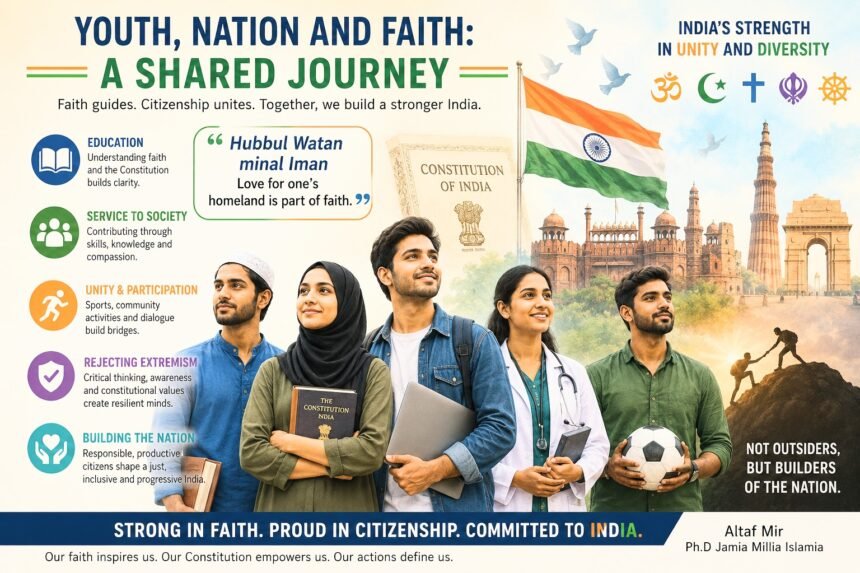
A major issue is the false belief that religion and patriotism cannot go together. This idea creates unnecessary confusion. In Islamic tradition, there is a well-known saying: “Hubbul Watan minal Iman” (love for one’s homeland is part of faith). This clearly shows that loyalty to one’s country is not against religion. For Indian Muslims, India is not just a place on the map. It is their home, history, and cultural space. Education plays a key role in removing this confusion. When young people understand both their religious values and the Constitution, they begin to see that the two are not in conflict. The Constitution guarantees rights and also expects active participation in nation-building. Practical action is where this balanced identity becomes visible. Skill development and service to society are important ways to express it. The idea of serving humanity encourages young people to contribute through their work, whether in technology, healthcare, education, or social reform. Even participation in sports and community activities helps build unity and reduces isolation. Instead of staying on the margins, youth need to be active contributors. The strongest response to doubts about loyalty is clear action – being responsible, productive, and committed citizens
India’s history also supports this idea. The freedom struggle was not based on a single identity but on unity in diversity. People from different religions and backgrounds worked together for independence. This shows that Indian identity has always been inclusive. When young people understand this history, they realise that their faith does not separate them from the nation. Instead, it connects them more deeply to its diverse structure. By respecting both their values and their constitutional rights, they help strengthen democracy.
A clear and confident identity also protects against extremist thinking. Radical ideas often attract those who feel confused or disconnected. These groups promote the false claim that religious commitment cannot exist with democratic values. However, when young people understand the Constitution as a system that protects justice, equality, and religious freedom, such claims lose their strength. Service to society turns ideas into real action. When young people work for the welfare of their community, helping others, improving local conditions, or promoting education, they become directly connected to the nation’s progress. This sense of responsibility builds belonging. It also reduces the chances of isolation, which is often used by radical groups to influence youth. Instead of withdrawing, engagement creates stability and purpose.
For long-term impact, it is important to encourage critical thinking and awareness. Countering radicalisation is not just about stopping violence; it is about building confidence and clarity. Young people need to understand that India’s pluralistic system is not something foreign. It has grown from its own history, shaped by the contributions of many communities. When youth see themselves as active builders of the country’s future, they no longer feel like outsiders. At this stage, youth are not choosing between religion and nation. That is a flawed way to look at the issue. They are combining both to form a stronger, more grounded identity. This balanced approach allows them to stay true to their beliefs while fully participating in the progress of the country. In doing so, they are not just shaping their own future, but also contributing to a more united and stable India.
Altaf Mir
Ph.D Jamia Millia Islamia