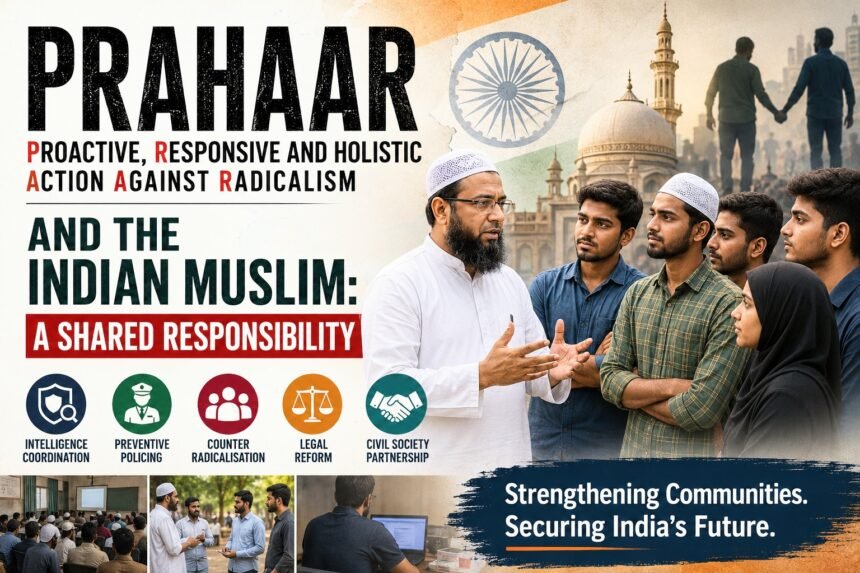
India has paid a heavy price for its lessons in counter-terrorism. From the violence of Partition to the militancy in Punjab, the serial bombings of the 1990s, and the Mumbai attacks of 2008, each tragedy has shaped the country’s security thinking. Now, that thinking is changing, Government’s proposed national counter-terrorism policy, named PRAHAAR, short for Proactive, Responsive and Holistic Action against Radicalism, marks a shift away from crisis management and towards prevention. Other democracies have learned this lesson too. Britain’s PREVENT strategy, the United States’ post-9/11 reforms, and France’s civic engagement model all recognise the same truth: the state alone cannot secure a country. Communities must be part of the solution. PRAHAAR reflects that same understanding.
The doctrine rests on five pillars. The first is intelligence coordination between different agencies to create a unified picture of threats. The second is preventive policing: acting before violence happens rather than reacting after. The third is counter-radicalisation through community engagement, education, and support for those vulnerable to extremist recruitment. The fourth pillar is legal reform, strengthening the Unlawful Activities (Prevention) Act while also improving its due process protections. The fifth, and arguably the most important, is civil society partnership. Without this, the policy remains a document rather than a deterrent.
Citizenship in a democracy carries moral obligations beyond simply following the law. Every Indian has a responsibility to challenge ideologies that undermine the Republic. For Indian Muslims, that responsibility has a specific dimension. Extremist narratives that exploit Islamic vocabulary can be most effectively challenged not by state agencies, but by Muslim scholars, imams, parents, and community leaders. They carry a cultural and theological credibility that no government official can replicats. When a knowledgeable imam explains why violent extremism contradicts Islamic teaching, it carries a different weight than a counter-terrorism briefing.
The evidence from other countries is clear. In Britain, Muslim community organisations were the first to identify how extremist networks were recruiting young people in northern English towns. In Germany, Muslim youth associations have run some of the most effective deradicalisation workshops in the country. In Indonesia, the world’s largest Muslim majority democracy, organisations like Nahdlatul Ulama have built a global reputation for countering extremist ideology through grassroots theological education.
India has its own examples. After the Muzaffarnagar riots of 2013, Muslim clerics and community groups in western Uttar Pradesh issued public fatwas against communal incitement and set up interfaith peace committees. The All India Ulama and Mashaikh Board has consistently spoken out against the Islamic State. These are not token gestures. They are acts of moral courage that deserve recognition and, importantly, institutional support.
For PRAHAAR to work, the civil society pillar cannot remain vague. Specific steps are needed. Mosques and community centres should be supported in running counselling and civic literacy programmes. Imams and community educators should receive training not only in theology but also in recognising the early signs of radicalisation and in how to respond. Pilot projects in areas with higher radicalisation risks could test these models, with findings audited independently and fed back into national policy. These projects must account for the real conditions on the ground which extremists routinely exploit.
Perhaps most urgently, digital literacy must become part of the agenda. Much extremist recruitment now happens online. Young people need the tools to critically evaluate what they see on social media, and Muslim youth networks are ideally placed to carry that message. The shift needed from Muslim civil society is also a change in posture: from reactive condemnation, issuing statements after attacks, to proactive engagement. That means mosque committees, youth groups, and community organisations becoming a standing, trained presence in the national counter-adicalisation effort, not just voices called upon in moments of crisis.
PRAHAAR represents a genuine step forward in how India thinks about national security. It recognises that prevention is better than response, and that the best counter to extremist narratives is a credible alternative, one that comes from within communities, not from above. The success of this doctrine will depend on trust, between the state and Muslim communities, and among citizens of all backgrounds who share a stake in India’s democratic future. That trust cannot be mandated. It has to be built, carefully and together.
-Altaf Mir
Ph.D Jamia Millia Islamia