Today, while the world is advancing through new stages of education, culture, and progress, the increasing incidents of violence compel us to reflect on the fact that human values are still under serious threat. God forbid, are we and future generations moving toward a time when the world becomes unliveable, and humans turn into bloodthirsty beasts against one another?
Wars across different parts of the world, terrorist activities claiming innocent lives, mob killings in the name of religion, attacks by deranged individuals, and suicide operations whatever reaction these events may evoke in you, they force us to think: if this cycle continues, turning into revenge upon revenge and violence upon violence, the world will become a jungle. Stopping this chain and eliminating the mind-set of violence is our collective responsibility. There are those who see violence as something to be countered with more force, and there are others who ignore it, believing it will not reach them. But the politics and dynamics of violence are like riding a lion easy to mount, but extremely difficult to dismount. It cannot be eliminated through violence, nor can one escape it by remaining a silent spectator.
In Mumbai’s Naya Nagar area, a man carried out a murderous attack on security guards of a housing society. Media reports suggested that he targeted them after asking about their religion. In our society, one’s name is usually sufficient to identify religion. Some reports also claimed that the attacker, an educated individual who had lived in the United States, asked the guards to recite a religious declaration before attacking them with a knife. Firstly, such a person cannot be considered mentally normal. Secondly, if this indeed occurred, it clearly indicates an intention to spread religious hatred and violence. Such incidents must not only be analysed legally, but also from moral, psychological, religious, and social perspectives.
If we consider this incident as a case study, it is not merely a criminal act but also a reflection of social decay, intolerance, and a violent mind-set. The renowned European writer and thinker Albert Camus divided crimes into two types: those driven by personal motives or desires, which affect individuals and their immediate surroundings; and those driven by ideology or collective causes, which can shake entire nations and societies. There is no need to repeat that such incidents suggest that someone intends to destabilize our country and push it toward greater destruction. Following the terrorist attack in Pahalgam, the recent incident in Mumbai is not an ordinary occurrence
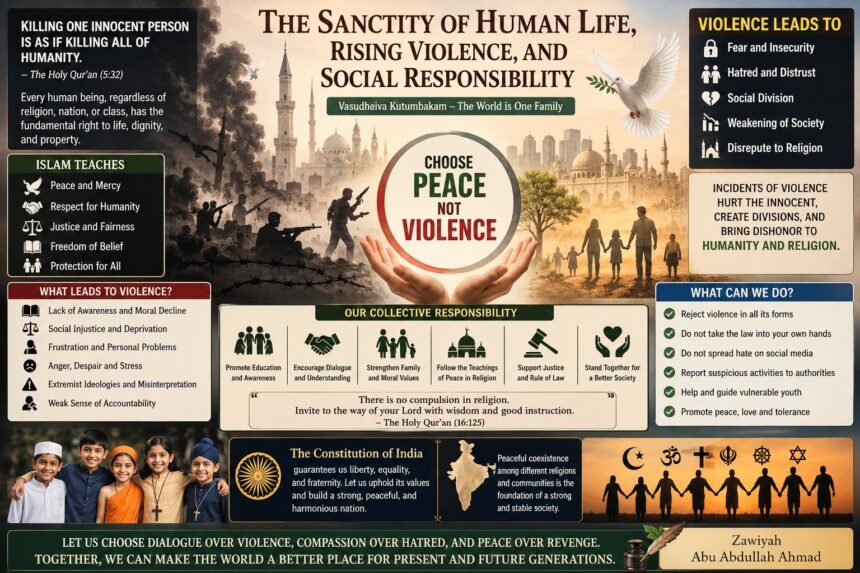
As far as Islam is concerned, it considers human life sacred. The Holy Qur’an clearly states that the killing of one innocent person is equivalent to killing all of humanity. The purpose of this teaching is to instil awareness of the value of life both one’s own and that of others. Every human being, regardless of religion, nation, or class, has the fundamental right to life, dignity, and property. This principle is not only part of Islamic teachings but also the foundation of any civilized society. Islam does not limit respect for human life to a particular faith, the rights of non-Muslims are equally protected under Islamic law.
Islam strongly condemns all forms of oppression, injustice, and violence. Harming innocent people for any purpose, personal or ideological, is strictly forbidden. Even in times of war, harming civilians, children, and the innocent is prohibited. In this context, any attack on a civilian is highly condemnable. Islam also clearly states that “there is no compulsion in religion.” Every individual has the freedom to follow their beliefs. The method of inviting others to faith is through wisdom, kindness, and good character not coercion, threats, or violence. When these principles are ignored, the true image of religion is distorted, leading to misunderstandings in society.
Islam does not permit anyone to take the law into their own hands. Terrorism, spreading fear, and targeting innocent people are unjustifiable under any circumstances. Such acts have no connection with Islam; rather, they are a blatant violation of its core teachings. A person who commits such acts cannot be considered a well-wisher of Islam or Muslims; even their claim of faith is deemed unacceptable by scholars.
Those who promote violence in the name of religion or ideology, spread hatred on social media, and manipulate vulnerable youth especially those suffering from despair or psychological issues are, in fact, pushing society toward instability and bringing disrepute to their own religion. The incident in Naya Nagar, Mumbai, can have multiple negative consequences. First, it creates a sense of insecurity among ordinary citizens. Second, it increases suspicion and mistrust between different communities. Third, it puts pressure on law enforcement agencies and creates false perceptions about entire groups due to the actions of one individual.
To understand such incidents, it is necessary to examine the underlying factors. Lack of awareness and distance from moral and religious teachings can lead individuals toward extremism. Social injustice or a sense of deprivation can also be a driving force. Some people express personal or societal frustrations through violence. Similarly, anger, despair, and psychological stress can contribute to such behaviour. At times, extremist ideologies or misinterpretations can radicalize individuals. In a society where the concept of accountability weakens, crime increases.
Both society and the Government bear responsibility to handle such incidents with sensitivity and precision. The fundamental message of Islam is peace, mercy, and respect for humanity. Promoting tolerance, patience, and mutual respect is the need of the hour. The Constitution of India also demands the same from us. We must strive to promote the values of peace, love, and tolerance in our homes, educational institutions, and social circles. Peaceful coexistence among different religions and communities is the foundation of a strong and stable society.
Zawiyah
Abu Abdullah Ahmad